
Tenemos nombre: container art by Idoia Leache

In Tenemos nombre, Idoia Leache brought the names of pioneering women in maritime professions onto shipping containers. Also titled Izena daukagu, the work won the eighth artistic interventions on containers competition in 2021.
The installation combines two large purple modules arranged in a cross with a smaller white container. Lettering turns their surfaces into a tribute visible from the surroundings of Itsasmuseum in Bilbao.
Customizable
The options are many as long as the habitability, watertightness and insulation standards are met. Both inside and outside you can paint, line wood, cladding, panels, etc.
Low prices
We are reusing a maritime container to adapt it to our needs, a transformation system that is already very present in countries such as Japan, the Netherlands or England and that allows us to offer anti-crisis prices, high qualities and short delivery times.
The containers we use are perfectly standardized, the most common being 10, 20 and 40 feet.
Each container is different, but similar in its resistant characteristics that make them suitable for transport.
The floor of the containers is in solidarity with the outer frame and the steel pillars. They are originally watertight and waterproof. They can be joined together by rigid or mechanical joints, and are stackable up to 5-6 heights depending on the load and use.
Energy saving
Factors such as sun protection, temperature, exposure environment and energy efficiency must be considered. There are systems that allow you to have a sustainable container and save energy depending on the use: recyclable materials, low environmental impact, high energy efficiency carpentry, energy saving installations using solar panels connected to underfloor heating, etc.
Versatility
Depending on the needs, they could be adapted to:
- Temporary or stable residence of one, two, three rooms or more.
- Office modules.
- Temporary businesses: kiosks, security posts, tourist office, stands, etc.
- Modules or annexes to the houses: tools houses in the garden, guest house or room modules.
- Bungalows located in camping.
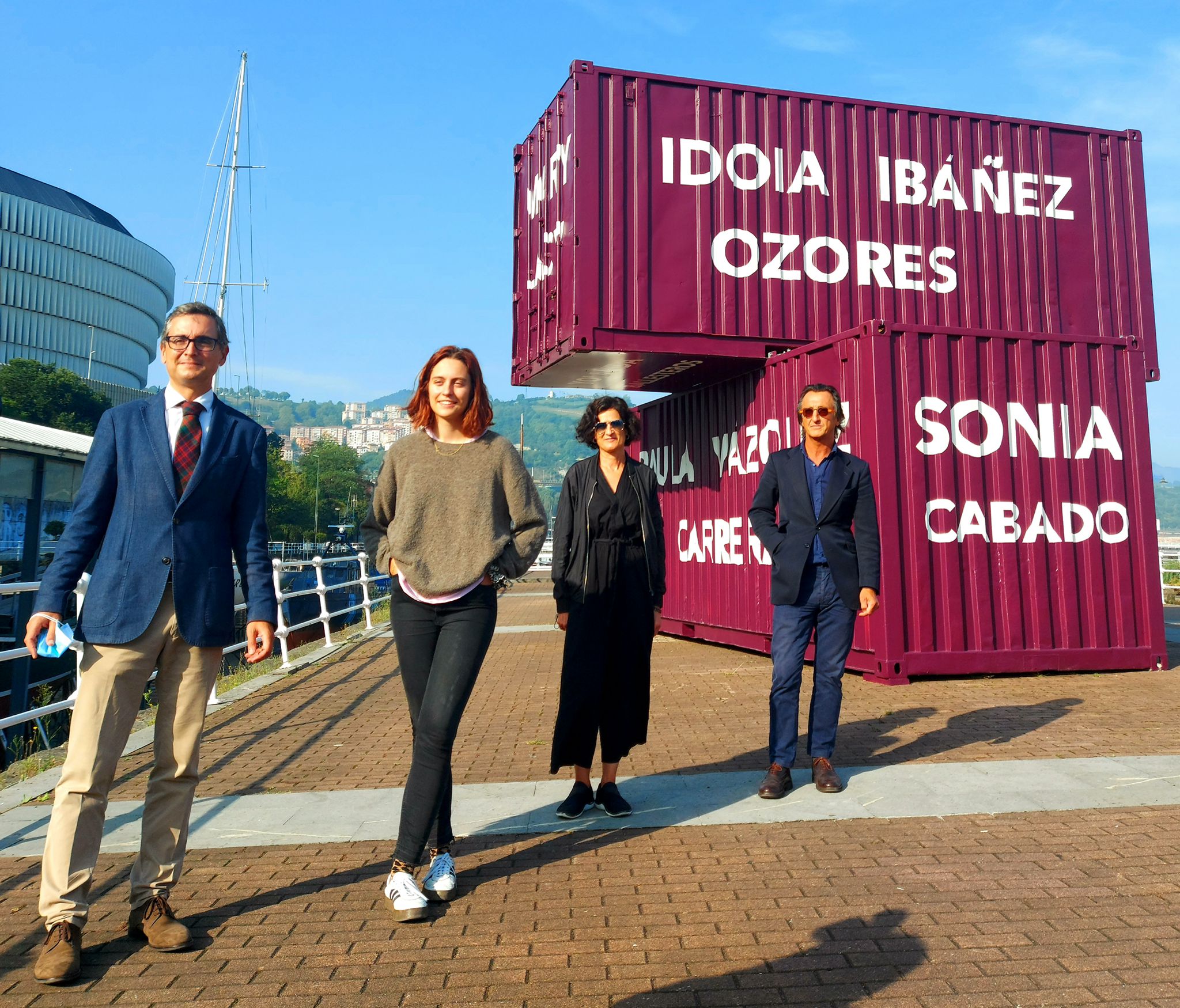
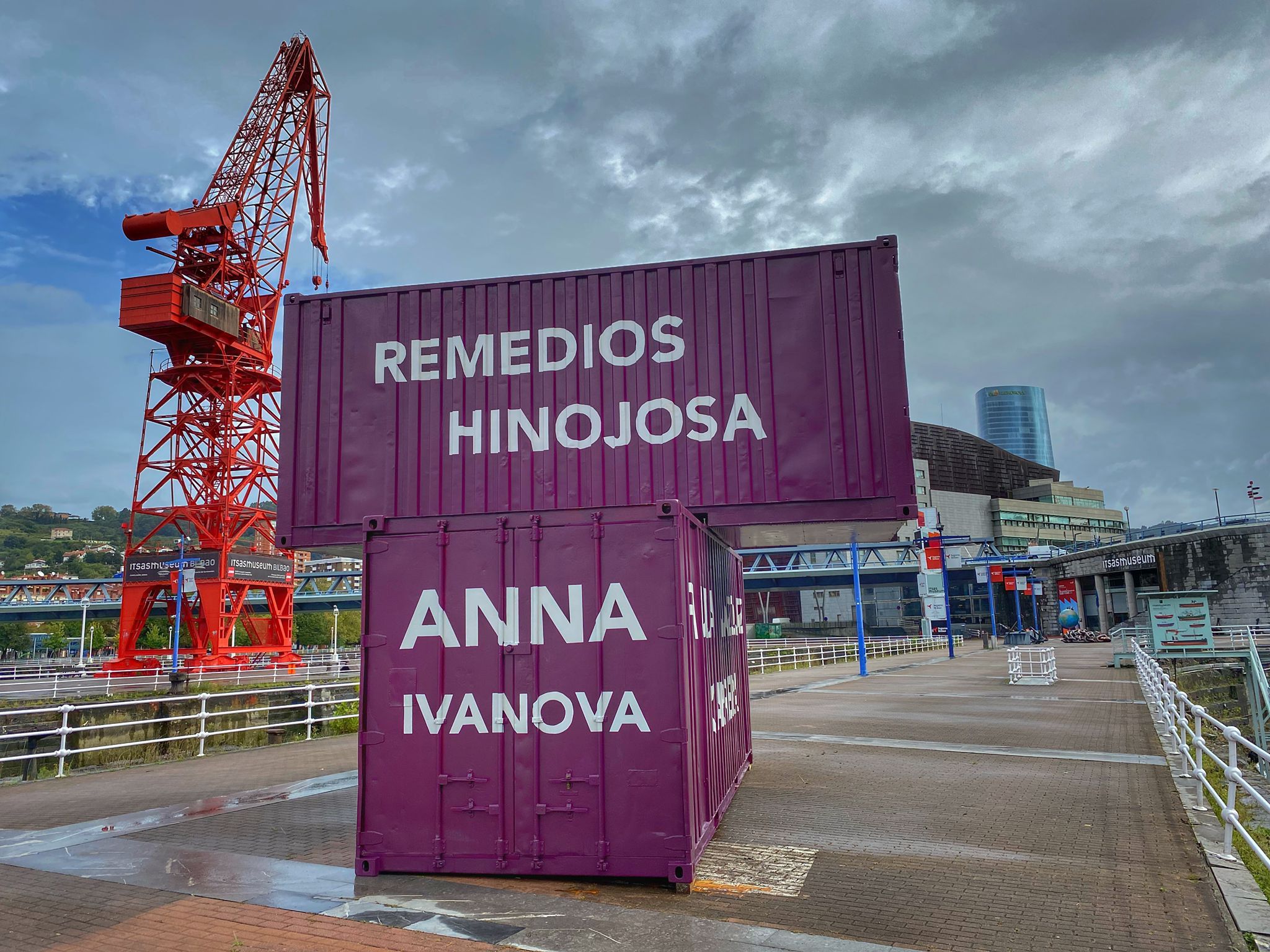
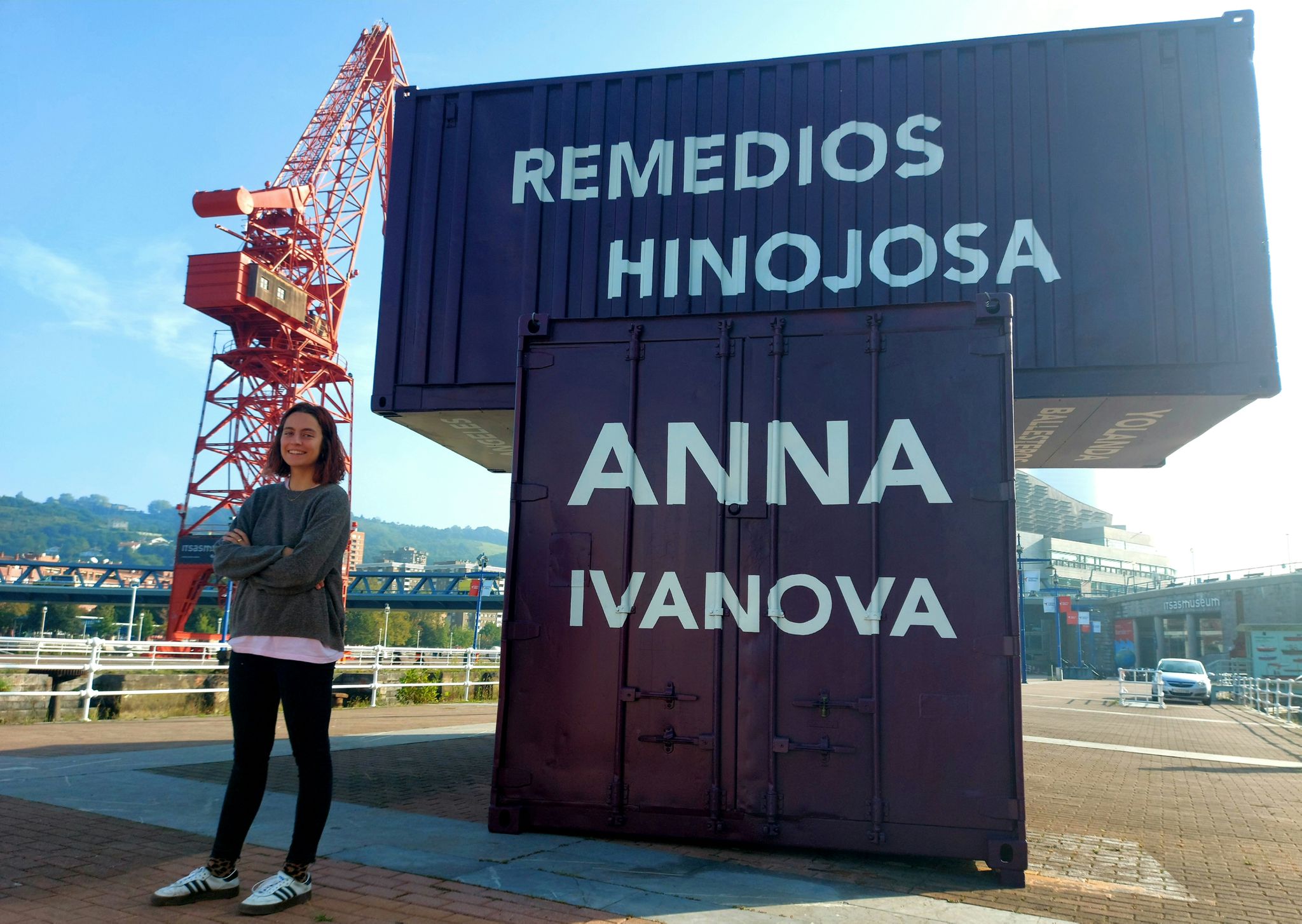
Tenemos nombre gives women’s names a public presence
The photographs show white lettering spread across the corrugated purple steel. Names including Anna Ivanova, Remedios Hinojosa and Idoia Ibáñez Ozores appear at a large scale. The crossed arrangement turns the written surfaces towards different parts of the promenade.
The gallery records the artwork and its presentation beside the Carola crane. The original account and biographical context are translated below, with a link to the UPV/EHU publication from September 2021.
Explore another intervention in the series through Leyre Arraiza’s work, or discuss a cultural project using containers with us.
Presentation archive: 24 September 2021
This account records the original presentation in Bilbao. The work was announced at that time for a one-year display on the Itsasmuseum esplanade.
Arantza Lauzirika, dean of the UPV/EHU Faculty of Fine Arts, Jon Ruigómez, director of Itsasmuseum Bilbao, and artist Idoia Leache presented the winning work in the eighth Artistic Interventions on Containers competition, organised by the UPV/EHU, Aurtenetxea Containers and Itsasmuseum Bilbao.
The competition invited Fine Arts students to work with industrial freight containers through painting, sculpture, audiovisual work, performance or other artistic disciplines. The temporary winning project was displayed on the museum esplanade, alongside maritime heritage including the former Euskalduna docks and the Carola crane, visible from both banks of the Bilbao estuary.
Leache, who had recently graduated in Fine Arts, arranged two large dark-purple containers measuring 6 × 2.5 × 2.5 metres in a cross, one above the other. A smaller white container, measuring 3 × 2.5 × 2.5 metres, stood diagonally a short distance away. Names of women from maritime professions were painted across the structures to recognise their contribution to naval history.
The women named in the work
The original presentation highlighted twelve women whose careers opened opportunities in a profession historically dominated by men:
- Anna Ivanova Schetinina: identified in the presentation as the first female merchant navy captain, in 1935.
- Victoria Drummond: engineering officer in 1922 and chief engineer from 1959.
- Lena Ringbom: the Finnish deck sailor first went to sea in 1931, aged 16.
- Mary Lacy: joined a ship as a carpenter’s apprentice in 1759, aged 19, using the name William Chandler to conceal that she was a woman.
- Conchi Rodríguez Rodríguez: a doctor in civil maritime studies who, at the time of the 2021 presentation, had spent eight years commanding passenger ships, ro-ro vessels and tankers.
- Idoia Ibáñez Ozores: the Bilbao-born captain whose pioneering appointment dated to 1994 in the original account.
- Remedios Hinojosa, “Reme”: the first female captain at Trasmediterránea.
- Ángeles Rodríguez Bernabeu: a pioneering merchant navy first officer in 1984.
- Yolanda Ballesteros: a pioneering engineering officer in 2001.
- Paula Vázquez Carrera: described in the original account as the youngest female officer to obtain the engineering officer qualification.
- María Ángeles Campos: the first female merchant navy captain from Galicia, in 2012.
- Sonia Cabado Sánchez: the first female chief engineer from Galicia, in 2007.