
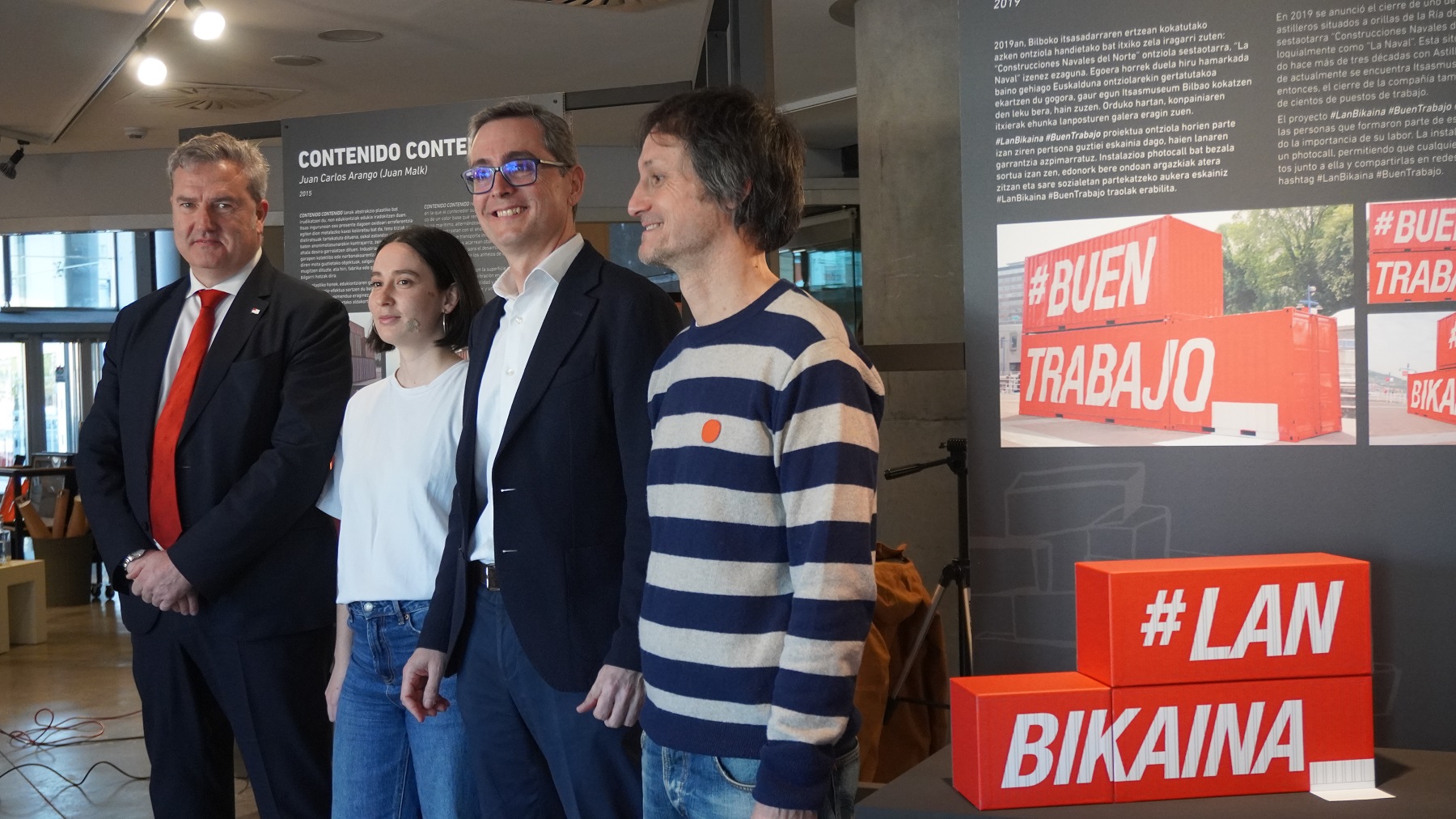
10 years of container art brought together the winning works from ten editions of the artistic intervention competition at Itsasmuseum Bilbao. The exhibition ran from 2 April to 29 June 2025 in Carol Iglesias Espazioa. This article records that exhibition and the projects behind it.
A journey through the winning works of ten editions
An initiative involving Itsasmuseum, the UPV/EHU, Bilbao City Council through Bilbao Ekintza, and Aurtenetxea Containers.
On 2 April 2025, the exhibition was presented at a press conference by Jon Ruigómez, director of Itsasmuseum Bilbao; Ismael Manterola, dean of the Faculty of Fine Arts; Javier Garcinuño, director general of Bilbao Ekintza; and Leyre Arraiza, winner of the tenth and final edition of the Artistic Interventions on Containers Competition. Her work, greentoblue.4 <3, was on display on the museum esplanade at the time.
The project began in 2013, when Itsasmuseum, in collaboration with the UPV/EHU and Aurtenetxea Containers, launched an art competition inviting students from the university’s Faculty of Fine Arts to transform shipping containers into urban artworks. The aim was to encourage creativity and artistic experimentation in public space.
In 2014, Bilbao City Council joined through its municipal company Bilbao Ekintza, alongside public and private organisations from the city. The collaboration sought to give visibility to Bilbao’s creative industries and support their development.
The ten editions covered a wide range of themes and artistic approaches. The exhibition offered a visual journey through the winning works, with photographs, models and a short explanation of each project. A catalogue was also announced for May.
Ten editions, ten projects
Ten editions took place, with the competition interrupted in 2020 because of the pandemic. The ten winning projects were produced and displayed on the museum esplanade.
The selected works were Baluarte 1,2,3,4,5 (2013), by Alberto Díez and Leo Burge; All Iron (2014), by Mar de Dios and Miguel Puertas; Contenido, contenido (2015), by Juan Malk; Paperezko Itsasontzia (2016), by Álvaro Aroca; El camino de la sirga (2017), by Xabi Dobaran and María de Viana; Plastikozko itsasoak (2018), by María Acuña Martínez; #Lan Bikaina #Buen Trabajo (2019), by Laura Martínez Martín; Tenemos nombre (2021), by Idoia Leache; La vida entre mareas (2023), by Fundación Punta Begoña; and greentoblue.4 <3 (2024), by Leyre Arraiza.
The ninth edition was an exception to the usual competition format. As part of the museum’s twentieth anniversary, a collaboration with Fundación Punta Begoña produced an exhibition about the estuary’s intangible heritage. The containers gave a voice to occupations connected with Bilbao’s maritime and industrial history.
The other editions were based on an open call for students from the UPV/EHU Faculty of Fine Arts, supporting local talent and giving emerging artists visibility in central Bilbao.
Many of the works explored the sea, sustainability, industry and the maritime history of Bizkaia. Some, such as Baluarte and greentoblue.4 <3, used sculptural arrangements to create an immersive experience. Others addressed industrialisation in All Iron, an introspective journey in Paperezko Itsasontzia, wishes in Contenido, contenido, and sustainability in Plastikozko Itsasoak.
El camino de la sirga and Tenemos nombre recognised women who worked along the estuary and at sea, while #LanBikaina #BuenTrabajo paid tribute to Euskalduna shipyard workers.
After the first ten interventions, the exhibition revisited the artists’ contributions, brought together the winning works and opened a discussion about how the initiative might continue. Admission to the exhibition was free.
Selected winning works from the container art competition
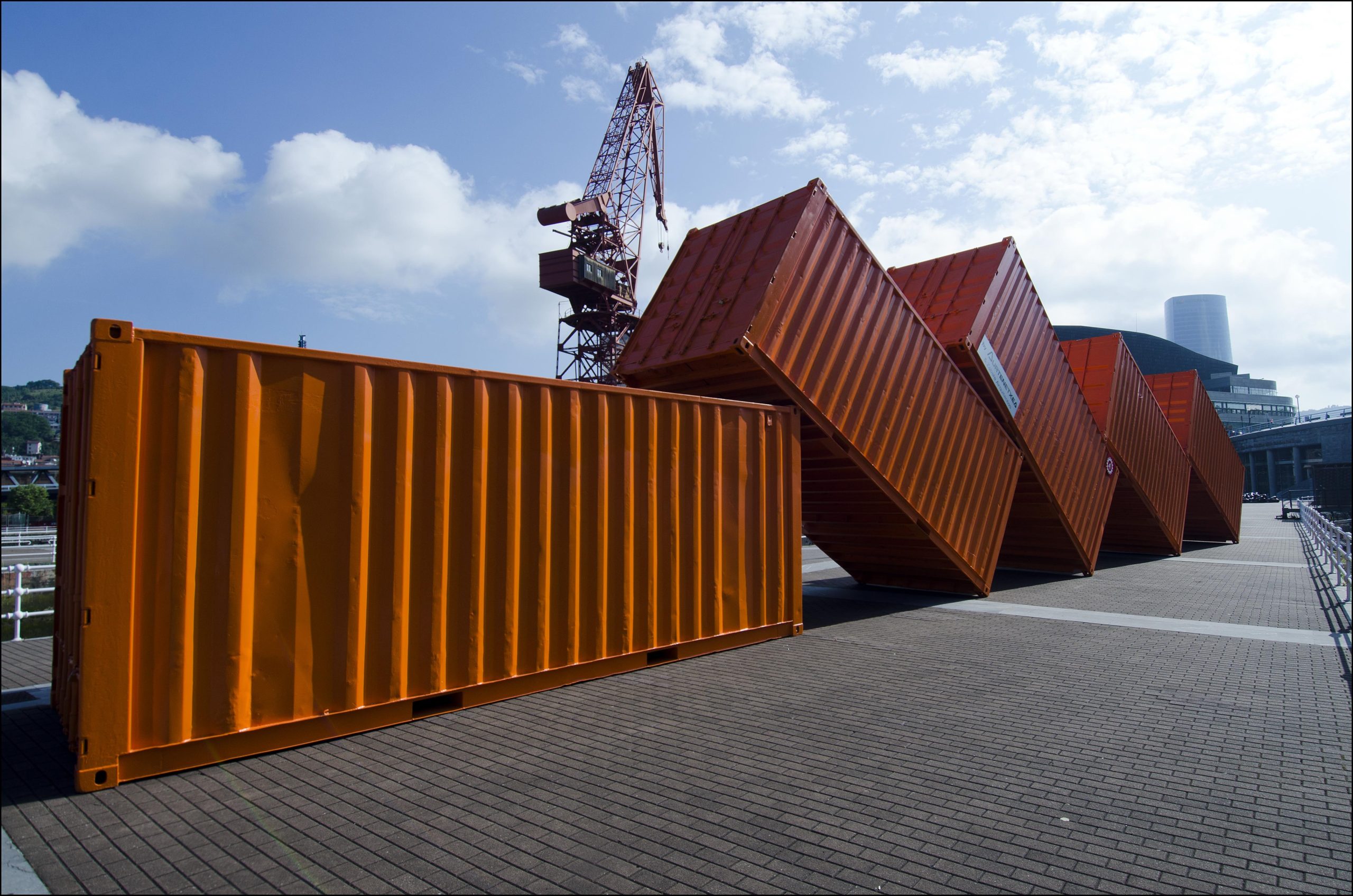
Baluarte 1,2,3,4,5
Alberto Díez and Leo Burge
2013
Baluarte 1,2,3,4,5 began as a temporary intervention in which upright containers were intended to be knocked down. The action never took place, and the work remained as a fixed structure: the possibility of a movement that never happened, like the trace of an unfinished gesture.
The orange colour was chosen for its contrast with the blue sky, making the installation stand out in the urban landscape. Despite its rigid arrangement, it creates an unexpected meeting point, bringing an everyday object into contact with a form that suggests play. It acts as a barrier on the esplanade, surrounded by established buildings.
ALL IRON
Mar de Dios / Miguel de Puertas
2014
ALL IRON pays tribute to Bilbao’s prosperous industrial years, a period that laid the foundations for the expansion of Greater Bilbao. The story behind the work recounts that, at an English-owned iron mining company in Bizkaia, the employer would display a sign reading “ALL IRON” when the extracted ore reached its highest purity.
For workers facing long hours, harsh conditions and low wages, this was said to be a reason to celebrate because their pay doubled. They would chant “¡Alirón! ¡Alirón!”, a chant that later became part of the anthem of the city’s football club.
CONTENIDO CONTENIDO
Juan Carlos Arango (Juan Malk)
2015
CONTENIDO CONTENIDO is a visual abstraction in which the container suggests its contents. The base colour of the metal box recalls the rust of the maritime environment, while bright colours contrast with the anonymity of a standard industrial shell carrying countless desires.
Industrial containers transport goods and materials needed for collective and individual life: a cold outer package for the aspirations of cities, factories and people. The colours and corrugated surface create a sense of vibration, vitality and movement, shifting between the rigid container and the idea of a gift box.
PAPEREZKO ITSASONTZIA
Álvaro Aroca
2016
Paperezko Itsasontzia explores the reconstruction of an evocative, drifting journey through a geometric figure emerging from three containers. The iron structures suggest a paper boat propelled by memories.
At its centre, an empty space invites reflection and remembrance, encouraging viewers to look beyond what is immediately visible. This void reinforces the boat’s fragility and its double material character: iron becomes paper and paper becomes iron, linking the temporary and the permanent.
Along the Bilbao estuary, viewers are invited to reconstruct their own journey, entering a dialogue between the material and the intangible as the metal paper boat sails towards the imaginary.
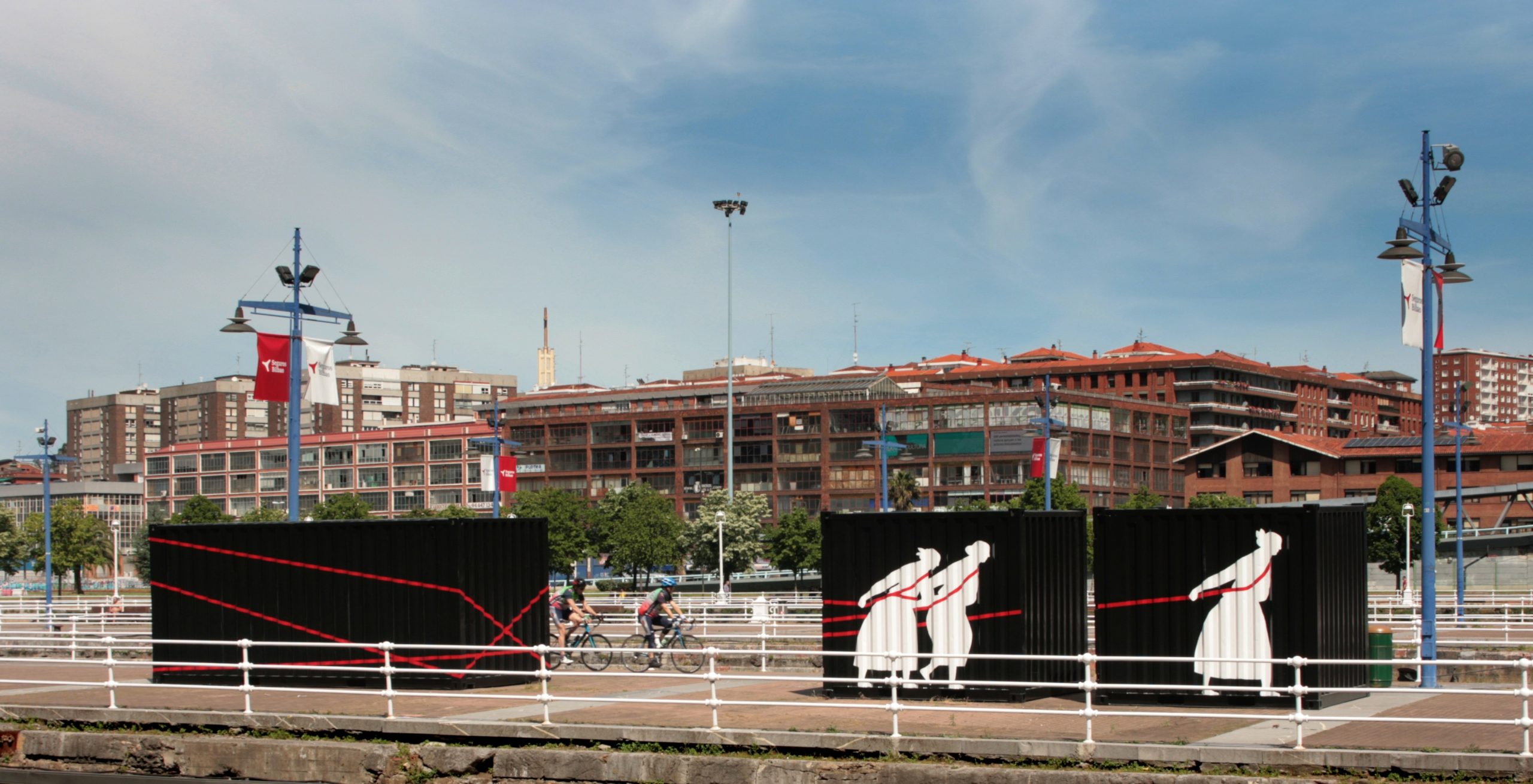
EL CAMINO DE LA SIRGA
María de Viana / Xabier Dobaran
2017
El Camino de la Sirga refers to the banks of the estuary and the demanding work of the sirgueras. These groups of women manually towed heavy cargo vessels from the riverbanks using ropes attached to their bodies. The practice continued into the first decade of the twentieth century.
The work depicts three slightly larger-than-life women towing a heavy load represented by a container. Their collective effort becomes a visual tribute to the people whose labour contributed to Bilbao’s growth.
PLASTIKOZKO ITSASOAK
María Acuña
2018
Plastikozko Itsasoak draws attention to plastic accumulating in the Bilbao estuary and its potential impact on the coast and marine wildlife. The artist invites viewers to consider how a simple plastic bag can affect a marine ecosystem.
The work depicts a fragmented fin whale with a cavity revealing plastic debris, as if exposing the animal’s stomach. Acuña collected the waste directly from the estuary. The installation points to the danger of plastic ingestion for marine animals.
Inside us, we carry the suffocating burden of your way of life.
Explore more container projects for cultural spaces.